


In recent years, a new word has steadily climbed the ranks of leadership literature and corporate strategy sessions: Agency.
While many managers intuitively grasp that it has something to do with employees taking ownership, the concept goes far deeper than simply “taking responsibility.” In an era of remote work, rapid market shifts, and high competition, understanding and fostering agency has become the ultimate differentiator between stagnant teams and high-performing, resilient organizations.
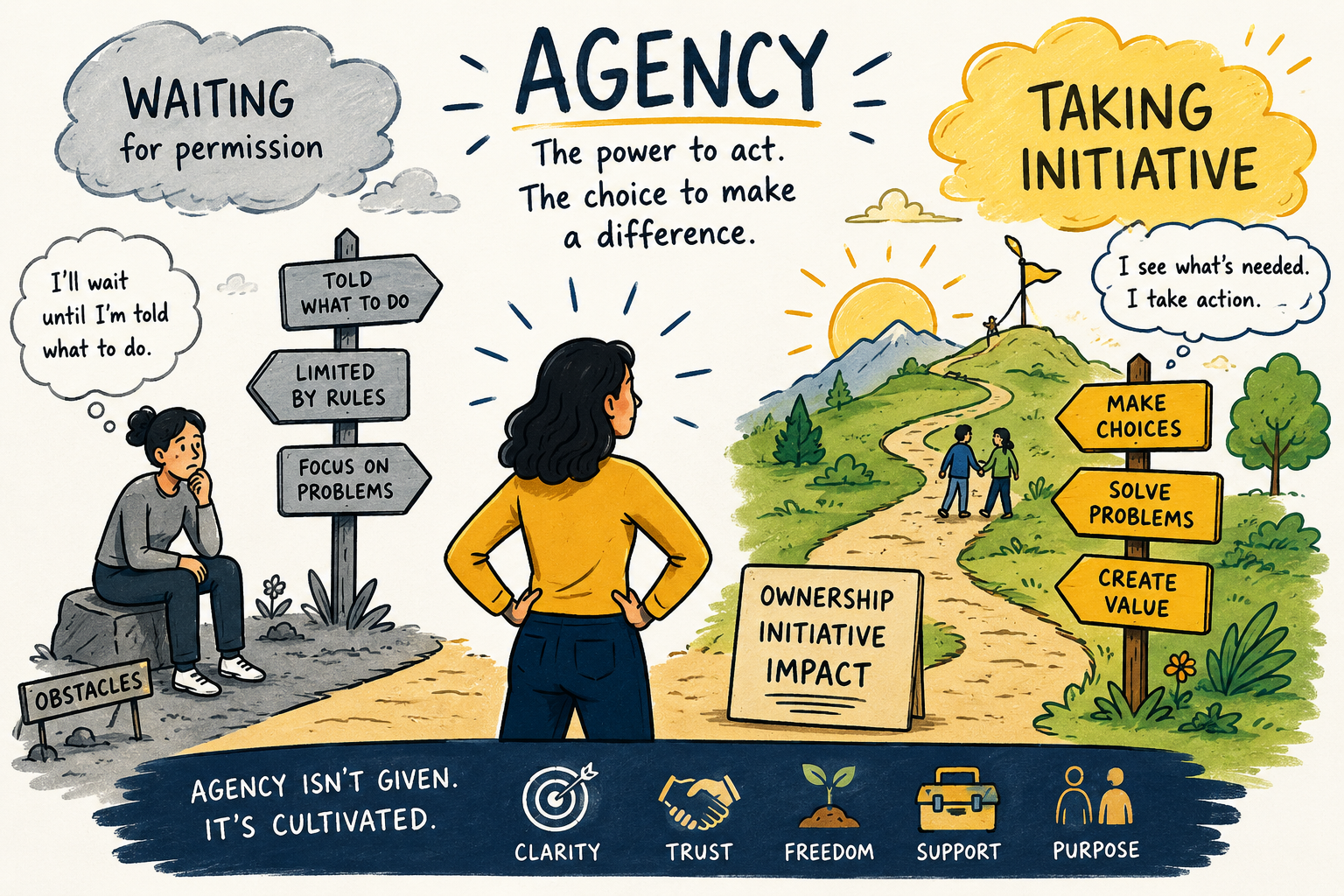
Defining Agency in the Workplace
What exactly does it mean? In a corporate context, agency can be defined as:
An individual’s perceived ability and actual opportunity to make conscious choices, initiate actions, and actively shape their own circumstances and outcomes.
To truly understand agency, we must break it down into two distinct, interconnected dimensions:
- Internal Agency (The Will): This is the psychological mindset of the employee. Does the individual possess a growth mindset and a belief in their own capability? A person with high internal agency does not see themselves as a victim of circumstances; they trust that their actions can influence reality.
- External Agency (The Way): This is where leadership comes in. You can have a team member with immense internal drive, but if they are trapped in a highly micromanaged, rigid environment, they have no actual agency. External agency requires structural mandate, resources, and trust from leadership.
While responsibility is often something you are given (a task to complete), agency is something you exercise—it is the freedom to decide how that task is solved and how your role evolves.
The Triad: Responsibility vs. Empowerment vs. Agency
To lead effectively, managers must stop using these three common buzzwords interchangeably. They mean very different things in practice:
- Accountability and responsibility define what someone is expected to deliver. They are often top-down and focused on the outcome and its consequences. When people are given responsibility without the means to influence the result, it can feel like a burden and create stress.
- Empowerment happens when leaders give people power, permission, or authority to act. This is positive, but it still keeps the hierarchy in place. Someone above you is allowing you to participate or decide.
- Agency comes from within the individual or team. When an organization cultivates agency, people do not wait to be empowered or given permission. They pro-actively take initiative, navigate obstacles, and shape their day-to-day work in line with the company’s goals and vision.
Example : A Customer Complaint
Responsibility:
“You are responsible for handling customer complaints.”
The person owns the task, but may still need approval for every solution. When responsibility is tied to an outcome rather than an output — such as “You are responsible for making customers happy” — it can become frustrating and stressful if the person lacks the authority, tools, or support needed to influence the result. Over time, this may contribute to burnout.
Empowerment:
“You can offer refunds or discounts up to 1,000 SEK without asking your manager.”
The person has permission and authority within clear limits.
Agency:
The person feels proud of the company and its products. Complaints are taken seriously and should be reduced. To achieve this, the person notices patterns in the complaints, works with others to fix the root causes, and improves the process so fewer customers experience the same problem again.
You cannot simply give people agency. You create the conditions for agency by giving them clarity, trust, freedom, support, and real room to influence the outcome.
More about how zero agency culture looks like, in the next post.
